OnePlus will be the latest company to pack the in-display fingerprint sensor, as Apple has allegedly postponed the technology to arrive on iPhone
By:-Tech News Team
OnePlus is a few months away from completing its cycle of launching two smartphones in a year. In May this year, the company launched the hotly-anticipated OnePlus 6 that jumped the bandwagon to join other Android OEMs and Apple to pack a notch. The OnePlus 6T, much like OnePlus 5T and OnePlus 3T, will debut this year with OnePlus having already divulged its plans to launch the device in October. The company has now gone ahead to announce that the OnePlus 6T will indeed pack an in-display fingerprint sensor.
In an emailed statement to CNET, OnePlus confirmed that the OnePlus 6T will feature the in-display fingerprint sensor and it will be called the ‘Screen Lock’. The in-display fingerprint sensor debuted with the Vivo X21 making Vivo the world’s company to bring such a technology. Since then, the integration of the fingerprint sensor into the display is something that other companies such as Xiaomi have taken up. OnePlus will be the latest company to pack the in-display fingerprint sensor, as Apple has allegedly postponed the technology to arrive on iPhone.
OnePlus told CNET in the statement – “We unlock our phones multiple times a day, and Screen Unlock reduces the number of steps to complete the action. By adding this feature as an addition to other display unlocking options such as Face Unlock, users will have options to unlock the display in a way that is most efficient for them.” It is noteworthy that OnePlus previously confirmed to CNET that the OnePlus 6T will launch sometime in October and tentatively cost $550 as a T-Mobile exclusive.
The current list of the smartphones that come with in-display fingerprint sensor includes Vivo X21, Vivo X21 UD, Vivo V11, Vivo Nex, Vivo V11 Pro, Xiaomi Mi 8 Explorer Edition, and Huawei Porsche Design Mate RS. The OnePlus 6T will be the fresh entrant to the league. Apart from this, the OnePlus 6T is expected to come with the water drop notch – a narrower notch in the shape of a drop that is seen on Oppo F9 Pro and Vivo V11 Pro. The smartphone is also said to sport a setup of three cameras.
Huawei Mate 20 series is slated to launch on October 16
Huaweiis all set to launch the Mate 20 series on October 16 at an event in London, and now the company has rolled out media invites, while simultaneously teasing the device and revealing some key details. According to the latest teaser, the Huawei Mate 20 is set to bring the latest 7nm Kirin processor, and sport more AI features. The Huawei Mate 20 and Mate 20 Pro are set to launch simultaneously, and the premium variant is largely expected to rock a triple camera lens at the back. To recall, the Huawei Mate 20 Litewas launched at IFA this year, with dual front and back cameras.
Perhaps the biggest confirmation on the new teaser is that the Huawei Mate 20 series will sport the new Kirin 980 system on chip, first launched at IFA 2018 as well. It is touted to be the world's first commercial 7nm (nanometre) system-on-chip (SoC), equipped with artificial intelligence (AI) capabilities. Compared to the previous generation 10nm process, the 7nm process delivers 20 percent improved SoC performance and 40 percent more efficiency, said Huawei.
Furthermore, the teaser claims that the Huawei Mate 20 and Mate 20 Pro are expected to have AI features in the camera as well as the overall UI. The teaser comes with the slogan "A higher Intelligence is coming", in which the AI abbreviation is highlighted.
Apart from this, the invite teaser reiterates that the event will be held in London on October 16. A recent report suggested that the Mate 20 and Mate 20 Pro both will have a display notch design and run Android Pie-based EMUI 9.0 out-of-the-box. While the Huawei Mate 20 Pro is rumoured to have an in-display fingerprint sensor, the Mate 20 is likely to include a traditional fingerprint sensor. The Mate 20 is also reported to have a 4,200mAh battery which is larger in capacity over the 4,000mAh battery available on the Huawei P20 Pro. The handset could also have a glass back construction to support wireless charging. In contrast, the Huawei Mate 20 Pro could come with a triple camera setup, similar to the P20 Pro.
As mentioned, Huawei already brought the Mate 20 Lite as the first model in the new lineup to expand its portfolio. The Mate 20 Lite doesn't have the top-end SoC and the latest Android experience. It instead comes with the Kirin 710 SoC and runs EMUI based on Android 8.1 Oreo.
If you have a newer Wear OS watch, sometime in the coming month, you’ll get a software update that will change what happens when you swipe on your watchface. Alongside the new UI, Google is also adding a new feed of information from Google Assistant, faster access to Google Fit, and a more information-dense view of your notifications.
It’s a much-needed cleanup and refinement for the big changes that came in Wear OS 2.0 (née Android Wear). That update changed a bunch of stuff to make it easier to get to apps and switch watch faces, but it also felt like a significant step backward when it came to reading notifications. Currently, you can swipe left or right to change watch faces. But when the new update hits, those gestures will map to something new, and you’ll need to long press to change faces.
Here’s what you will see on your watch using the new system, starting from the main watchface:Swipe right: Google Assistant feed of information
Swipe left: Google Fit’s new fitness - tracking rings
Swipe up: notifications
Swipe down: Quick Settings shortcuts
Long press on the watch face: change watch face
Short press the main button: see all apps
Long press the main button: invoke Google Assistant to ask questions via voice
Let’s examine the changes one by one. The most important change is the one you see above: a feed of information from Google Assistant. It’s designed to show you relevant info about your day, like calendar details, package-tracking info, and the weather.
It’s very similar to the Siri watchface on the Apple Watch. It’s also similar to the “visual snapshot” feature that was recently added to Google Assistant on phones. (However, on both iOS and Android, that feature is buried under a confusing button.) Most of all, it’s similar to a once-highly touted thing called “Google Now,” which purported to give you predictive information cards about your day.
I’m not sure what Google is calling this feed. It’s just referring to the information as “proactive” help. The company seems more interested in pushing the general idea of Google Assistant than putting a clear brand identifier on this feed.
Next are notifications, which operate basically the same as before. They still mostly mirror what’s on your phone. Dismissing a notification on your watch will do the same on your phone, and many apps will allow you to quick reply with suggested chips. But the best feature here is that Google is going back to a more information-dense display that puts all your notifications on a single, scrollable pane instead of having them fill the entire screen one by one.
Swiping left will now take you to the new Google Fit interface, which shows the two new rings that Google is has created to track your health. One is “move minutes” and the other is “heart points.” You can read more about what those rings mean and why Google changed up Fit here.
Last but not least, swiping down takes you to a slightly revamped Quick Settings pane, which adds two oft-requested buttons: one for finding your phone and another for Google Pay. More (but perhaps not enough) Wear OS watches come with NFC now, and the Google Pay button will make sure that the chip is on and ready to pay when you walk up to the point-of-sale terminal.
Oddly enough, Google wasn’t willing to say whether this update to Wear OS is getting a version number; until it rolls out, I can’t say whether it’s Wear OS 2.1 or 2.5 or whatever. It’s a relatively quiet update for a platform that has had a relatively quiet year (or more). I’m glad to see Google iterating on the software, and the changes do seem to be an improvement. But software tweaks aren’t the problem.
The problem is that we are still waiting for a good processor that fashion brands and tech companies can use to make watches that don’t all look like variations on the same theme: a kind of thick, kind of slow, circular watch that can only make it through a single day of use before dying (less, if you use GPS or LTE). Qualcomm says that it’s coming — potentially this year.
For both Android and iPhone users right now, Wear OS has a ton of different watches you can choose from, but none of them are very good. There are a bunch of signs that Google is looking to change that: this software update, the coming Qualcomm processor, the revamped Google Fit, and a new emphasis on increasing the quality of Wear OS apps are all signs that point to a more serious attempt to take on the Apple Watch.
If that’s all true, we should start seeing a new generation of Wear OS watches that are actually worth considering, and rumor has it that Google may make a “Pixel Watch.” It’s very nearly make-or-break time for the platform — and the clock is definitely ticking.
A day after clearing the last regulatory hurdle vis-a-vis the National Company Law Tribunal (NCLT), Aditya Birla Group announced on Friday that Vodafone India and Idea Cellular have completed the merger to create India's largest telecom company. The combined entity that boasts of 408 million active subscribers and a revenue market share of 32.2 per cent replaces Airtel as India's number one telco. Both Vodafone and Idea will continue to operate as independent brands post the merger, Aditya Birla Group has confirmed.
"Today, we have created India's leading telecom operator. It is truly a historic moment. And this is much more than just about creating a large business. It is about our vision of empowering and enabling a new India and meeting the aspirations of the youth of our country. The "Digital India", as our Honourable Prime Minister describes it, is a monumental nation-building opportunity. As Vodafone Idea, we are partnering in this initiative by building a formidable company of international repute, scale and standards," Kumar Mangalam Birla, chairman of Aditya Birla Group and Vodafone Idea Limited, said making the announcement.
The newly appointed Board also announced names of the new directors and named additional promoters of the merged entity called Vodafone-Idea. The Board has appointed Balesh Sharma as the CEO of Vodafone-Idea.
"As India's leading telecom operator with two popular and loved brands, the company has the scale and resources to ensure sustainable customer choice and introduce new technologies. We are committed to offer both our retail and enterprise customers an excellent experience while fulfilling their evolving digital and connectivity needs via new products, services and solutions. We will offer them more network coverage, more value and more excitement," Balesh Sharma, CEO, Vodafone Idea Limited said.
The Vodafone-Idea merger has been a long time coming, and now that it is completed, it is expected that India's telecom scene will be subject to some more changes. India's telecom market will now literally be governed by three companies, Vodafone-Idea, Airtel and Reliance Jio. The newly formed Vodafone-Idea Limited will have a large spectrum portfolio of 1850 MHz and an adequate number of broadband carriers to boot, something that it hopes would help it to fight competition and get more subscribers on-board. The merged entity will provide services across 2G, 3G and 4G platforms.
"We will continue to offer a wide variety of digital services and solutions under both of our popular and loved brands (Vodafone and Idea). Services - including Voice, Data, Mobile payments, IoT, advanced enterprise offerings and entertainment - will all be conveniently accessible via digital channels and extensive on-ground presence of 15,000 branded stores and 1.7 million retail touchpoints across the country," Vodafone-Idea said in a statement.
The merger although it is expected to generate Rs 140 billion annual synergy will be also under a net debt of Rs 1.09 lakh crore
Google Tez will now be rebranded to Google Pay, the company announced at the 2018 edition of the Google for India event held in New Delhi on Tuesday. Rich interactions are coming to Google Pay, and Google aims to empower 150,000 retail stores in India to use Google Pay by Diwali 2018. Additionally, businesses and merchants can now pay for Google Ads using Google Pay. Google claims that over 1.2 million small businesses in India are already using Google Tez (now rebranded as Google Pay).
All things you love will remain same," said Caesar Sengupta, GM, Payments and Next Billion Users Initiative at Google, at the event emphasising the fact that this is a mere rebranding exercise and not the dilution of a pre-existing service.
The many things that you love about the app - the familiar contacts on your homescreen, the one-touch mobile recharges, and of course the fun offers and rewards - are all here to stay. In fact, over time we’ll bring many of these features to Google Pay users in other countries just as we’ll bring features we have launched elsewhere to India," Sengupta added in a blog post.
Google Pay is getting integration for loans in collaboration with Federal Bank, HDFC Bank, ICICI Bank, Kotak Mahindra Bank, and others. The loans will be pre-approved and will be given only to bank customers through the banks. Google Pay will essentially work as an intermediary. The pre-approved loans start appearing in the app in the coming weeks.
At the event, the tech giant announced that 22 million people now use Google Tez every month and have made a total of 750 million transactions since launch in September last year. The company also claimed that monthly BHIM UPI transactions have grown 14x since the launch of Google Tez.
The rebranding rollout will complete in the next couple of weeks. Merchants will get the option to enable payments directly from their app where customers can just swipe the Pay button to make payments to their nearby merchants. There will also be an option to show a QR code to customers to make seamless payments. The merchants will get transaction history on their app along with the picture and name of the customers and the amount they’ve paid as well as the transaction ID for each transaction happened in the past.
Back in March this year, Google Tez had added a simple chat feature allowing users to communicate with their contacts alongside simultaneously sending and receiving money via UPI.
At I/O 2016, Google unveiled its own voice assistant Google Assistant, and made it available in Allo chat app and the Google Home smart speaker initially. It is now available on most Android phones out there, and is regularly updated with more features. India has been a priority for Google since the start, and the Assistant supported English and Hinglish (a mixture of English and Hindi) since the initial days, before being made available in Hindiearlier this year. Now, at the Google for India 2018 event held in New Delhi on Tuesday, Google has announced new India-specific features for Google Assistant, with support for Marathi also introduced. The tech giant is also working with several local service providers to bring more functionality to the Google Assistant.
Google also announced that support for seven other Indian languages is in the pipeline. Furthermore, Google Assistant is also getting the ability to talk in regional languages as well. This feature is coming soon, and to activate it, all the user has to say is, "Okay Google, Talk to me in Hindi" or any of the other supported regional languages of their choice. Because of this, Google Home will also be able to talk in Hindi in the future. Asserting its importance of the Indian market, Google says that it has doubled down the localisation on Google Assistant since launch, and its usage has notably tripled in India since 2016.
Google is also working with several third-party apps to bring more functionality on Google Assistant. It is working with Where Is My Train to introduce the ability to locate trains, and Hello English integration will help Indian users learn English using Hindi through Google Assistant. It is also working with Airtel to allow users to check plan expiry date, new recharge options, existing plan details, and even recharge directly through Google Assistant.
Separately, Google has also launched a new India Builds Actions campaign to get more Indian developers involved in making software to extend the functionality of the Google Assistant. This campaign looks to show Indian developers how to build their Actions on Google in English and Hindi in just 15 minutes. Head to the Actions on Google website to learn more about building software for Google Assistant.
At the Google for India event, the Mountain View firm also announced it was re branding Google Tez as Google Pay, and also unveiled Project Navlekha to help offline publishers in India get online. There were also several other Search and Android Go based announcements, including the bilingual (English and Hindi) for Google Feed and the new Google Go ability that lets users listen to webpages.
Xiaomi Poco F1 has been launched in India as the first smartphone from Xiaomi to be powered by the Qualcomm Snapdragon 845 SoC, 8GB of RAM and more. Here are all the details about Xiaomi Poco F1 price and specs By:- Tech News Team
Xiaomi Poco F1 has been launched in India after much speculation and while it is the first smartphone from Xiaomi’s new sub-brand Poco, it is also the Chinese smartphone maker’s first smartphone in India to be powered by Qualcomm Snapdragon 845 SoC under-the-hood. On the other hand, the Xiaomi Poco F1 is also one of the first smartphones in India to support both 4G+ and dual VoLTE connectivity.
The Xiaomi Poco F1 has been priced at Rs. 20,999 for the 6GB RAM/64GB storage option, Rs. 23,999 for the 6GB RAM/128GB storage option and Rs. 28,999 for the 8GB RAM/256GB storage option while it will be made available exclusively through Flipkart in India. The Xiaomi Poco F1 will be made available in Rosso Red, Graphite Black, and Steel Blue colour options. On the other hand, there is also a POCO F1 Armoured Edition with 8GBRAM + 256GB storage which is priced at Rs. 29,999.
As far as the launch offers are concerned, Xiaomi Poco F1 buyers will get an instant discount of Rs. 1,000 on purchases made through HDFC Credit cards via EMI option. On the other hand, Reliance Jio users will also get Rs. 8,000 worth of benefits and upto 6TB free data. Poco has also launched four new Poco skins for the Xiaomi Poco F1 starting at just Rs. 299.
To round it all up, #POCOF1 will be made available in premium polycarbonate, a material that's durable and comes in 3 exciting colors. We're also bringing you the Armored edition with real Kevlar for the most premium flagship you've ever experienced! #MasterOfSpeed
The biggest highlights of the Xiaomi Poco F1 include the Dirac HD Sound and dual smart PA for loud and clear audio, a 4000mAh battery with fast charging, up to 8GB RAM + 256GB (UFS 2.1 storage), LiquidCool Technology where copper heat sinks with water vapours inside sits on top of SoC, dual rear cameras backed by AI, a display notch and more.
Xiaomi Poco F1 specifications
The Xiaomi Poco F1 sports a 6.18-inch FHD+ LCD display with 500 nits brightness, 2.5D curved glass and Corning Gorilla Glass. It is powered by the Qualcomm Snapdragon 845 SoC under-the-hood coupled with Adreno 630 GPU for graphics. It includes 6GB/8GB of RAM with 64GB/128GB/256GB inbuilt storage, expandable up to 256GB through a microSD card. The Xiaomi Poco F1 comes with hybrid dual SIM connectivity, it runs Android 8.1 Oreo (upgradable to Android P) with MIUI for Poco on top which offers features such as Poco launcher, turbocharged engine, and fast updates.
To deliver fast & seamless experience, we focused on 3 different components on MIUI for POCO. 1. POCO launcher. 2. Turbocharged engine. 3. Fast updates. #MIUIForPOCO#POCOF1
For optics, there is a dual rear setup including 12-megapixel (Sony IMX 363) with 1.4um pixels for better low-light photography, f/1.8 aperture, 4-axis OIS, Optical zoom, 4K video recording and 5-megapixel sensors coupled with dual-pixel autofocus, AI scene detection and a dual-LED flash. The front-facing camera includes a 20-megapixel shooter with Pixel binning technology, real-time AI photography. The Poco F1 is backed by a 4000mAh battery with Quick Charge 3.0 support.
Connectivity options include dual 4G VoLTE, USB Type-C, Dual-Band, Wi-Fi Hotspot, Wi-Fi 802.11 a/b/g/n/ac, Wi-Fi Direct, Bluetooth 5.0 LE, GPS + Glonass while for biometrics, the Xiaomi Poco F1 comes with a rear-mounted fingerprint scanner and AI-backed Infrared Face Unlock for biometrics.
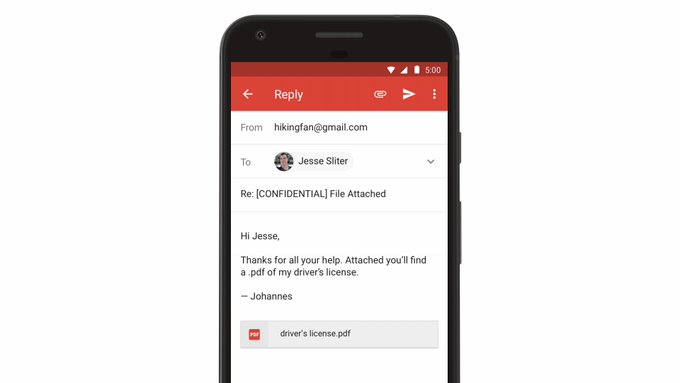
The new Confidential Mode allows users to send emails that expire after a set amount of time and the recipients will not able to forward, copy, print or download them
By:- Tech News Team
Google has announced that it will be rolling out ‘Confidential Mode’ for Gmail iOS and Android. The new mode lets users send emails that expire after a set amount of time. Further, recipients of these emails will not be able to forward, copy, print or download them. However, they will still be able to take screenshots if they want. Further, recipients who have malicious programs installed on their computer may still be able to copy or download the sent messages or attachments.
Sender’s also get an option of setting up a SMS Passcode in order to open the message. If selected, the recipient will get a SMS with a passcode that will be needed to open the mail. Senders also get the option of stopping a recipient from reading the email before the time limit expires.
To recall, the ‘Confidential Mode’ was added to Gmail on desktop a while back as part of aredesign for Gmail. However, reports suggested that the US Department of Homeland Security (DHS) has issued an intelligence notewarning users of the “potential emerging threat… for nefarious activity” with the new Gmail redesign. The DHS noted that the Confidential Mode “presents as opportunity for malicious cyber actors to mimic the email message and phis unwary users. Attackers can reportedly send emails using confidential mode and make use of phishing links to get access to a victim’s personal information.
Confidential mode is now available on mobile devices and can help you protect sensitive information from unauthorized access. Learn more about this feature → http://goo.gl/u7VEnL


/cdn.vox-cdn.com/uploads/chorus_asset/file/12676603/Swipe_Right___Assistant.gif)
/cdn.vox-cdn.com/uploads/chorus_asset/file/12677497/Swipe_Up___Notifcations.gif)
/cdn.vox-cdn.com/uploads/chorus_asset/file/12677607/Swipe_Left___Fit.gif)
/cdn.vox-cdn.com/uploads/chorus_asset/file/12677761/Swipe_Down___Shortcuts.gif)